Chopping off my hair for The Little Princess Trust

It's impossible for me to understand just how distressing hair loss can be for a child going through cancer treatment or other hair losing diseases such as alopecia. On my head, my hair is just long strands of superfluous keratin that I should probably brush more often, but once donated and made into a wig, it would give a child battling these awful diseases a small token of normality once again.

The cost of manufacturing and purchasing a custom wig, especially for smaller heads can cost up to £2000, but The Little Princess Trust provides real-hair wigs free of charge to boys and girls across the UK and Ireland. I have had hair down to my hips for a while and I'm going to have at least a foot (12 inches/ 30cm) cut off to make into a wig for someone who will appreciate and deserve it far more than I do. I hope that my hair donation can bring a little happiness to a brave child.

Myself and The Little Princess Trust would really appreciate it if you can donate/sponsor any amount you can so that they can continue their priceless work. Thank you to those who have already done so.

Please TEXT: OINK77 £3 to 70070 

or donate via my JustGiving page

Thank you.

C25K: My Running Essentials

I have never been a sporty person and over the last two years, I have epitomised the term "couch potato". The only exercise I partook in was a weekly session of sitting at the side of a badminton court, chatting to my friends during what our school called "PE lessons".  However, as detailed in my last post "1 Month of Self Improvement", I am determined to get off my lazy bottom to become fitter and overall better version of myself by starting to go running.

When I began this journey a mere week and half ago, I felt wheezy after just 2 minutes of running. Now after just 5 runs, I am already feeling a difference in my endurance. I've still got a long way to go but I have taken the first step in the right direction. Here are the two items that have really motivated and aided my efforts:

NHS Choices: Couch to 5K Podcasts
The NHS have done something right and produced a fantastic running program for absolute beginners like myself. The weekly podcasts initially start with only short spurts of running, broken up by periods of walking, gradually increasing in difficulty each week to 30 minutes of straight running by week 9. Laura, the narrator of the podcasts has an encouraging tone of voice and the music is not as half bad as I thought it was going to be. Best of all, the entire program is free to download - there is no excuse to not go outside and get running!

OMRON Pedometer
This item is more of a luxury than a necessity but I have enjoyed using my pedometer to count my steps,  fat/calories burnt, and miles kilometres ran. This incredibly small and lightweight device has helped to motivate myself to improve on  previous runs as it stores data for up to the previous week. There are countless mobile apps that provide a similar function but since we already owned this little device and my phone is obsolete, this pedometer is perfect for my needs.

I have never envisioned myself as someone who would enjoy running but it has made such a difference, not only to by fitness but my overall mood. Now I look forward to exercise, rather than scowl at the thought of it. Let's see how long this lasts - I will continue to document my progress!

1 Month of Self Improvement

I have exactly 29 days before my last ever high school examinations. What happens in these 29 days will determine whether I will be able to attend the university of dreaming spires. However, even if my miss my target grades, there is no doubt that I will still be able to attend decent university through the likes of clearing. Thus, I am not going let the pressure and stress of these exams overwhelm me, but to utilise the cortisol hormones racing round my body to become the optimum studying machine. I  firmly believe that what you do in the weeks prior to your exams is more important than what happens when you are sitting in the school hall, frantically scribbling onto your test paper. In terms of becoming a better human being, the skills and knowledge that you are able to acquire from such acute studying is far more beneficial than the grade you receive a piece of paper in a brown envelope.

Therefore, I will commit myself to 4 weeks of solitude and studying.   This sounds drastic but 4 weeks is only a drop in the ocean in terms of  a lifetime, yet the results of my hard work can cause shock-waves to my journey in life. This is the last final sprint in my chapter of childhood - I can do it.

However, sitting on my bottom however many hours a day studying is a mentally draining task. The cabin fever nature of spending so much time in one house in one room, sitting in the one spot can easily become overwhelming. Also, spending so much time at home is dangerous as there is a seemingly endless supply of delicious food right at my finger tips. Studying is an arduous and often boring task and my favourite coping mechanism is to continuously snack. To combat both of these mental and physical hurdles, I am going to exercise every day which is incredibly unfamiliar territory for me. I am a couch potato so I have started the NHS' "Couch to 5K plan". Hopefully I can apply the same determination to my A Levels to this plant to become a fitter and happier person. 

Here is what I envision my daily timetable for the next 4 weeks to be like:
10.00am: Wake up
10.10am: Watch "itsjudyslife" daily vlog on YouTube
10.30am: Breakfast
11.00am: Revision
1.00pm: Lunch
2.00pm: Revision
4.00pm: Run
5.00pm: Revision
7.00pm: Dinner
8.00pm: Watch "Grand Designs"/ a movie/ relax/ more YouTube/ blog
12.00pm: Go to sleep
Once my one month of self improvement is over, I have a summer of freedom and bliss. Fun things I have to look forward to include prom, parties, Birthday, Brighton, Nayland, Hunan, China camp, CYO residential and hopefully INTERRAILING! I am almost there - one last push! 

Inspiration for this post: 


New Year's Resolutions for 2014

It is that time of the year again for New Year's Resolutions. I don't think I officially made any last year but I do enjoy setting these as goals and targets I wish to accomplish by the end of the year. If anyone is interested, click here to see the resolutions I made for the year of 2012. 2013 has been a very busy and at times stressful year, but ultimately very rewarding. Key highlights include:

  • January included the trials and tribulations of running my own Young Enterprise company.
  • I can't remember what else I did over February, March and April apart from visiting the Big Bang Science Fair for a second year. 
  • May was  time for hoards of AS exams that turned out fine.
  • June was a fantastic start to the summer with a Headstart summer school at Oxford University for materials science where I met some of the most talented, multifaceted and friendly people I have ever encountered.
  • July is my birthday month where I celebrated at Eton College at the Universities Summer School. Those 14 days were some of the most academically exhausting  (4 hours of homework for some nights) yet enlightening two weeks I have ever experienced. I will never forget the horrific practice interview I had in the morning of my actual birthday, or the surreal sunset party on an island that Eton own that we had in the evening. 
  • I traveled to Madrid in August along with CYO where we had the privilege of playing an open air concert in the medieval town center of Toledo right in front of the facade of the glorious Gothic cathedral. 
  • I scrambled through September, attempting to trawl through hoards of research, doing some frantic essay writing and cutting it very short with deadlines in order to complete my Extended Project on the Millennium Bridge. Luckily all was well by the end of this ordeal.
  • October was the month where I forced myself to decided on where I was planning to apply for university and for what course.
  • November was an relatively uneventful month, apart from attending university interviews and multiple fancy dress parties where I made appearances as a red indian, Ahmed the pizza delivery man and the Cheshire Cat. I have also been busy with preparing for the Physics Aptitude Test and for other presentation evenings .
  • December is drawing to a close. During this month I have attended grueling university interviews at Oxford which I will talk about in further depth at a later date. I also was also part of the orchestra for our school's performance of Wind in the Willows. 
I feel like I have grown up over 2013 and become more confident as a person. Now that 2013 is over, here are my New Years' resolutions for this year. I have only got four this year but I believe that they will all have a profound impact on my life. 

Read 24 books over the course of 2014.
I know this sounds terrible but over my teenage years, I think I have only leisurely read enough books to count on one hand. I used to be a relatively keen reader as a child, annually participating in summer reading challenges but I lost my interest. However, over the later half of 2013, I got back into the habit of regularly reading in order to complete my wider reading specified in my UCAS application and really enjoyed it. I rediscovered the wonders of the library and since I have recently acquired a quite a large pile of books I want to get through as well as book vouchers, so I thought it would be a worthwhile resolution. 24 books may not seem to be a particularly large number, but the books I am currently reading are all pretty heavy reads. 

Cut all sugary drinks and snacks out of my diet.
This may seem quite extreme but I honestly don't really get much enjoyment out of eating sweets or drinking hot chocolate and they are detrimental to many aspects of your health.This ban will include all sweets, chocolate bars, fizzy drinks, sugary hot beverages from the likes of Costa etc, and biscuits. I don't really consume these foods that often anyway as it's only when I have lots of music rehearsals that these items are abundantly supplied. This is when I think it is going to be the most challenging to say no to them. I feel like I have quite good self-discipline but we shall see how this pans out. 

Brush my hair at least once a day.
My hair can now be officially classified as being in the very long category of hair lengths. It is pretty much hip length and thus is more high maintenance that it has been ever previously been. I often avoid brushing my hair as it is painful and the back often gets extremely matted. However, in order to prevent my hair becoming too straggly, I shall attempt to remember to brush it at least one a day.

Get into university.
This is rather self-explanatory. 2014 is hopefully going to be the year where I move out from the same house that I've lived my entire life in move to a fantastic city to study a subject I am absolutely passionate about. 

How does your Quartz Watch Work?

Developments in technology have a profound impact on society which I am sure you all know about. However, at the beginning of its research, these fields are often incredibly esoteric so today I am going to talk about a piece of technology that everyone owns and you may even be wearing one right now: a quartz watch.

Every single time piece relies on something oscillating with a constant time period. In a mechanical watch, there is a swung balance wheel, when in a quartz watch, it is a tiny quartz crystal, otherwise known as silicon dioxide or just sand. The crystal has piezoelectric properties, so when it is mechanically deformed, whether that is being squashed or bent, a small electric charge accumulates causing a small electric currrent - this is how we create a spark with barbeque lighters. However,  like most things in physics, it can also work in reverse: when we pass a current through the crystal, it will deform. This is what causes the quartz to oscillates and ultimatly keep time.

Piezoelectricity In Detail

This is all a very nice description of what happens, but what is the mechanism that actually causes the quartz to deform when a current is passed through? When an asymmetrical crystal is subject to mechanical stress, there is a change in the overall polarisation and dipole density of the crystal. This is actually quite similar to how capacitors work, which I have currently been studying about in physics. Any spatially separated charge, such as in a dielectric in a capacitor will result in an electric field, therefore an electric potential. In a piezoelectric device, mechanical stress, instead of an externally applied voltage is what causes this charge separation in the individual atoms of the material. When an AC current is applied, the crystal will mechanically resonant and the frequency of the resonance is determined by the physical dimensions of the material, the "cut angle" with respect to the crystalline axis of the original crystal and the ambient temperature.

Why use Quartz?

Many materials exhibit piezoelectric properties, but why was is quartz specifically chosen to be used inside millions of watches today Well it is incredibly abundant in the Earth's crust and apart from its piezoelectric properties, it also has many other attractive properties that make it ideal for use in a wrist watch. The accuracy of a quartz watch is due to its high mechanical and chemical stability. As mentioned above, changes in ambient temperature can change the frequency of the resonance, however, quartz actually has a low temperature coefficient that means that is relatively little change of physical property when the temperature changes. Quartz also has a high Q a resonance which basically means how under damped the oscillator is - A higher Q factor means that there is a lower rate of loss of energy relative to the stored energy in the oscillator and oscillations die out more slowly. Since quartz is also incredibly hard and relatively inert, it you can rely on the  crystal not faulting during the lifetime of the watch.

Measuring Time

So now that we understand why the quartz was chosen and why it vibrates, how do our wrist watches count seconds and tell us the right time? The quartz crystal is cut by a laser into a 3mm tiny fork shape which means that the current from the battery makes it vibrate at 32768hz +/- 0.06hz. This specific number is chosen as it is exactly 215 hz (oscillations per second), meaning some simple circuitry can easily use this to determine the time interval between each second. This is also why there are regular pulses per second with the second hand in a quartz watch whilst a mechanical watch moves continuously. Then it's all the simple matter of gears in the correct ratio to move the minute and hour clock.

Conclusion

Once owning a horological device was one of prestige and privilege, but since the perfect piezoelectric properties of quartz crystals were first ulitised in a wrist watch in the 1960s, the price of watches have dropped to the point of disposability. They are  incredibly accurate to within 5 seconds/month, more accurate to an order of magnitude when compared to mechanical watches and only surpasses in long term accuracy by primary atomic stands such as Caesium and Rubidium. I believe that they have truly revolutionised the world we live in and that is ultimately what the whole point of manipulating and using these weird quirks in the natural world to improve human life is all about.

Why Air Bazookas are endless fun

"I'm having so much fun."
Something that I have been curious about for a while are air bazookas. As you can see from my picture from the Big Bang 2012 Young Scientists' and Engineering fair (which I wrote an entire blog post about here), the air vortex cannon or bazooka is a toy which fires doughnut shaped rings of air - or smoke if you fill up the cavity with smoke - that are strong enough to ruffle hair, knock over cans and scare neighbours pets after travelling several meters. It has always intrigued me how these doughnuts of air can travel so far, are formed so easily and are stable, so I am going to attempt to answer these questions in this blog post today.

Toroidal vortices
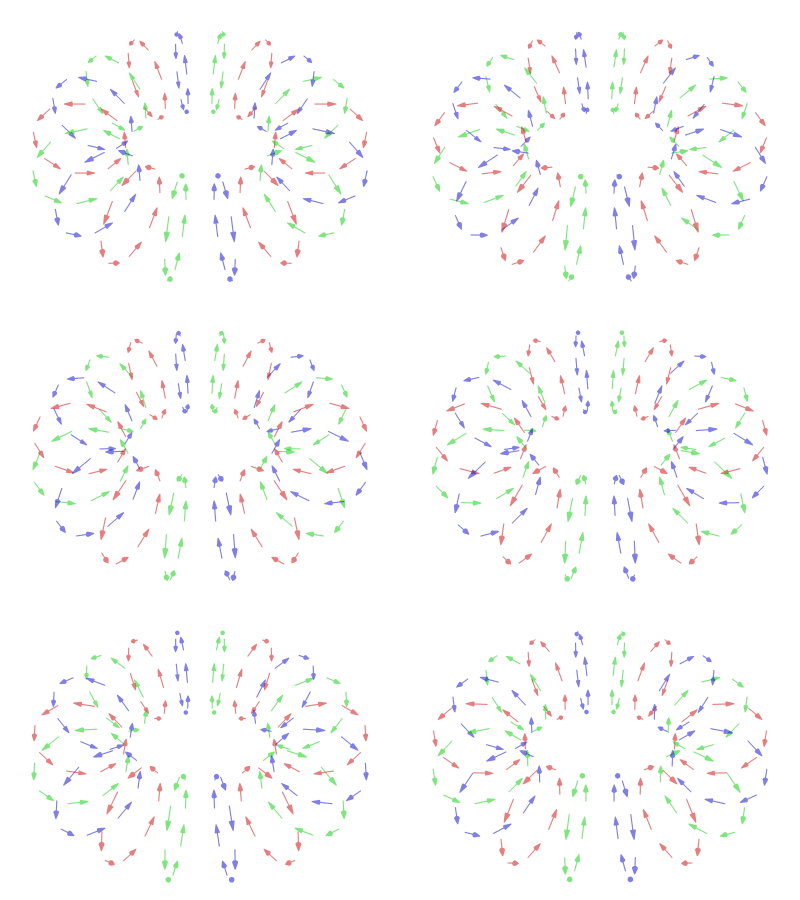
One of the main reasons why Air Bazookas are so fun is due to their funky doughnut shaped smoke clouds they produce. When you force a large volume of fluid through a small hole, you will get a toroidal vortex. This sounds very technical and esoteric, but a torus is just the mathematical description of a doughnut shape and a vortex is the spinning motion of a fluid - it's the doughnut rings of air that are fired out of the air bazookas.

How are they formed?
  1. The diaphragm of the air bazooka is pulled back and released, suddenly pushing air out of the bazooka. As the air approaches the hole, it has a uniform velocity.
  2. As it passes the hole, the air on the edge is slowed down by the drag from the surface of the hole, as well as coming into contact with the stationary air outside the bazooka. This forms a velocity gradient with the air in the centre of the hole/ inner layers having the greatest velocity and the air at the circumference/ outer layers with the lowest velocity.
  3. This velocity gradient causes the inner layers of air to "roll" around the outer layers, forming the vortex. Imagine an air molecule towards the outer layer - it is being pushed harder from the inner layers as they are travelling at a faster velocity than the air on the outer layers, giving the air angular momentum and causing it to spin.
Why are they so stable?
Another reason why Air Bazookas are endless fun is due to the fact that the air doughnuts hold their shape for a relatively long time before dissipating. Toroidal vortices are incredibly stable due to the fact that moving fluids exert less pressure on their surroundings than still fluids. Air molecules are constantly colliding with each other and their surroundings as they are a gas, meaing that there is air pressure. When you disturb air, there is still the same amount of kinetic energy, but more is in the direction of motion and less on the surface, meaning the pressure is lower for fluids with higher velocity. I'm not sure if that is a 100% correct derivation, but what we are discussing is Bernoulli's Principle: the fast air moves, the lower the air pressure.

Since the velocity of air inside the vortex is greater than the velocity of air outside, there is also higher pressure surrounding the torus, which squeezes and maintains its shape. This net inwards pressure acts with the same principle as vacuum packaging to make the toroidal vortices very stable.

Why do they travel forward?
A further reason why Air Bazookas are so fun is that you can aim and fire them at other people - for us to understand why we can do this, we must appreciate why they travel forward in the first place. As the flow of air in the vortex "rubs" against the still air, friction causes the torus to move itself forward. This is exactly like how a bicycle wheel works: if you imagine a spinning bicycle wheel which is then dropped on the ground, the friction between the spinning wheel and the ground would cause it to move forward. Another analogy is like how a swimmer pulls himself/herself along through the water.

The energy required to move the ring forward and to keep the vortex rotating comes from the momentum of the rotating air inside the vortex. Air has momentum as it has mass. The spinning air inside the torus is where energy is stored - once all this energy is used up through work done to overcome the frictional forces, the doughtnut of air dissipates.

Why do they travel so far?
The last reason why air bazookas are so fun is that you can aim and fire air doughnuts at people several meters away. The reason why this is possible is the poloidal flow of air in the vortices - the flow of air around the "width" of the doughnut. Since the air is moving, the friction between the vortex and surrounding stationary air decreases, meaning that longer distances can be travelled with little loss of mass and kinetic energy with air doughnuts than if it was just a jet of fluid.

So in conclusion, it's all a matter of fluid dynamics.

I feel like I should start referencing where I get my information from. Here are my main sources:

Plans for the Summer Holidays

For once, I actually have a decent amount of free time this summer so I am eager to make the most of it and not spend all of it sleeping or watching movies on my laptop, even though that is probably what will happen.
This is what I aim to achieve over the next few weeks

Academic Goals:

  • Decide on what degree course I actually want to take - I know, I haven't even done that yet
  • Write my personal statement
  • Apply for work experience in October
  • Cover C3 content
  • Cover physics A2 content
  • Cover chemistry A2 content/ do tech coursework, depending on which I will take on next year
  • Complete EPQ
  • Read, read and read

Recreational Goals:

  • Write a "recreational" blog post on here about any science that interests me every day that I don't have a "planned" activity for the day
  • Learn about what my dad actually does for a living
  • Practise violin ready for the tour
  • Learn to play bass - songs I want to learn include
    • Hysteria by Muse
    • some songs from RHCP - not decided which ones yet
    • Get Lucky by Daft Punk 
    • Blurred Lines by Robin Thicke
    • Street Life by The Crusaders
    • Katachi by Shugo Tokumaru 
    • Feels Like We Only Go Backwards and Apocalyptic Dreams by Tame Impala

Social Goals:

  • Socialise at least twice a week - lol. 
  • Try not to become a complete recluse
Related Posts Plugin for WordPress, Blogger...